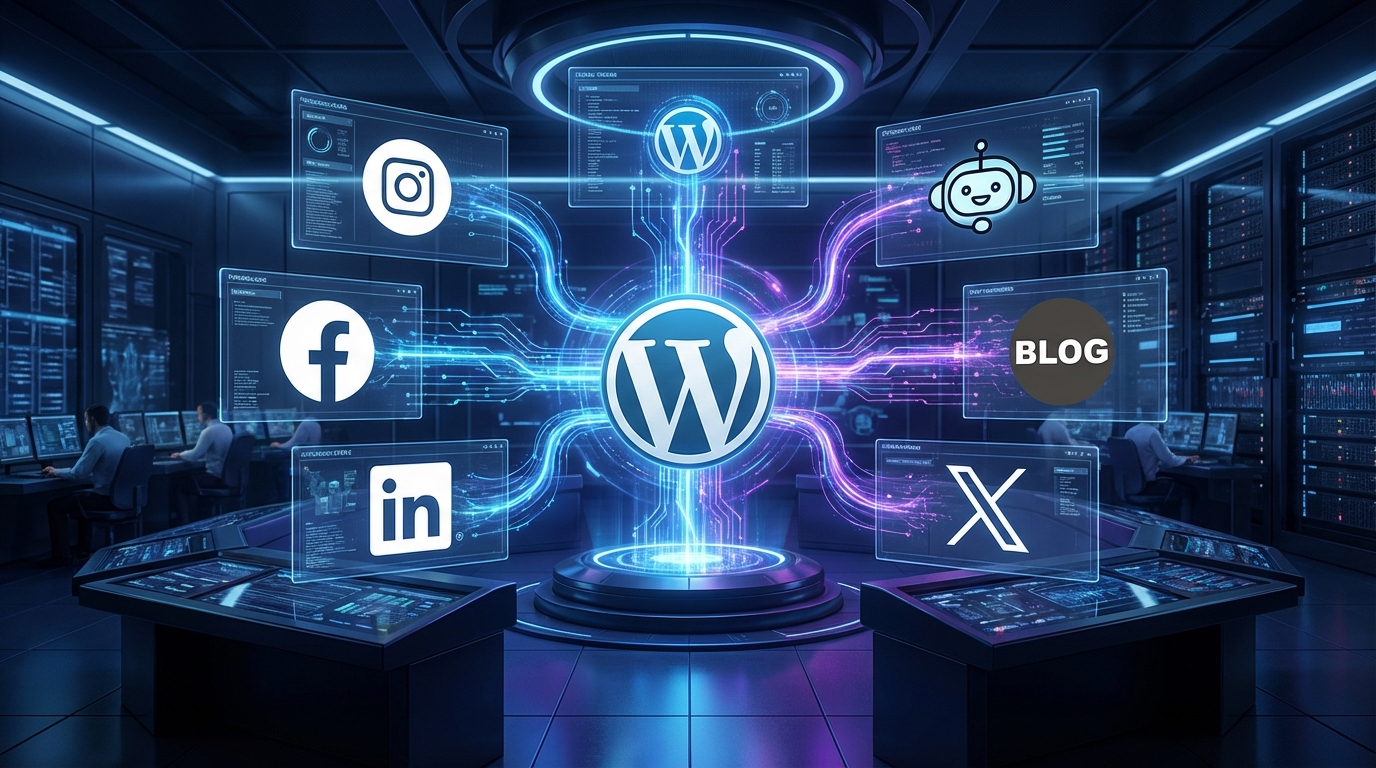
Conventional social media management for WordPress websites relies on a fragmented ecosystem of plugins and external tools. This approach creates operational inefficiencies, data silos, and limitations in automation scalability. For digital marketing agencies and business owners, the manual configuration and lack of intelligent coordination between content creation, scheduling, and analytics result in significant time expenditure and suboptimal performance. The transition to a more integrated, intelligent system is a technical necessity for achieving genuine marketing automation. An agent-based model, operating directly within the WordPress environment, offers a superior architectural solution. This framework moves beyond simple, trigger-based posting to establish a cohesive, AI-driven system that manages the entire social media content lifecycle. It provides a structured methodology for transforming a standard WordPress installation into a proactive, automated social media engine, capable of executing complex strategies with minimal human intervention. This document provides a technical framework for this deployment.
Defining the social media automation architecture in WordPress
A robust social media automation architecture within WordPress requires a conceptual shift from isolated plugins to a centralized, agent-based system. A standard plugin typically executes a single, predefined function, such as syndicating a published post to a connected social profile. It operates as a discrete tool with a narrow scope. In contrast, an AI agent, as implemented in a platform like SynergizeFlow, functions as an integrated system component. It possesses a broader operational context, capable of accessing and processing data from multiple sources within the WordPress environment, including post content, user engagement metrics, and site analytics. The architecture of an agent-based model is fundamentally different. It is designed around a core processing engine that orchestrates multiple tasks. This includes content analysis, derivative content generation, intelligent scheduling based on performance data, and multi-platform API communication. Unlike a plugin, which is a passive tool awaiting a command, an AI agent is a proactive system that can initiate actions based on its programmed objectives and data analysis. For marketing agencies, this architectural distinction is critical. Managing multiple client websites with individual plugins is inefficient and not scalable. A platform architecture allows for the deployment of standardized AI agents across multiple WordPress instances, all managed from a central control plane, ensuring consistent execution and simplified reporting.
Core components of an AI social media agent
An effective WordPress social media AI agent is composed of several distinct, yet interconnected, technical components. Understanding these components is essential for its proper configuration and deployment. The first is the Content Ingestion Module. This module is responsible for sourcing raw material for social media posts. It directly interfaces with the WordPress database to access published posts, pages, and custom post types. Advanced configurations allow it to identify key themes, extract specific data points, and recognize content formats. The second component is the AI Generation Engine. This is the core processor that transforms the ingested content into platform-specific social media updates. It utilizes natural language processing (NLP) models to generate text variations, including headlines, summaries, and calls-to-action, tailored to the character limits and audience expectations of each social network. The third component is the Intelligent Scheduling Logic. This moves beyond simple cron jobs or fixed-time schedulers. It analyzes historical engagement data to determine optimal posting times for each platform, maximizing visibility and interaction. This logic forms a feedback loop where performance data continually refines future scheduling decisions. The final critical component is the Multi-Platform API Integrator. This module securely manages authentication and communication with the APIs of various social media networks. It handles the technical protocols for posting content, retrieving analytics, and ensuring compliance with each platform’s terms of service. Together, these components form a complete, autonomous system for content creation and distribution.
Step 1: Establishing content generation parameters
The initial phase in deploying a social media AI agent involves the precise configuration of its content generation parameters. This process defines the rules and constraints that govern how the AI engine creates derivative content from the source material on the WordPress site. The first parameter to establish is the Content Source Definition. The administrator must specify which post types the agent is authorized to access, such as ‘posts’, ‘products’, or other custom types. This prevents the agent from generating irrelevant posts from administrative pages. The next step is to configure the Tone and Style Guidelines. This involves providing the AI with descriptors and examples that align with the brand’s communication strategy. Parameters may include settings such as ‘formal’, ‘technical’, ‘instructional’, or ‘promotional’. This ensures that all generated content maintains a consistent brand voice. Following this, Format Variation Rules must be set. This instructs the agent on the types of content to create for each social platform. For example, rules can be created to generate a concise, professional summary for LinkedIn, a question-based post for Facebook to drive engagement, and a short, declarative statement with relevant hashtags for Twitter. Finally, Exclusionary Keyword Filters are established. This is a critical step to prevent the AI from generating content about sensitive or off-brand topics. A list of keywords and phrases is provided, and any content containing them will be automatically flagged or discarded by the agent. Proper configuration of these parameters is foundational to the agent’s success.
Step 2: Configuring the AI scheduling and optimization engine
Once content generation rules are established, the focus shifts to configuring the AI scheduling and optimization engine. This component elevates the system from a simple auto-poster to an intelligent distribution platform. The initial configuration involves setting a Baseline Posting Frequency for each connected social media platform. This parameter defines the desired volume of content, such as ‘post to LinkedIn once per day’ or ‘post to Twitter three times per day’. This provides the AI with a starting point for its operations. The next, more critical step is to enable the Dynamic Optimization Algorithm. Instead of relying on a fixed, user-defined schedule (e.g., ‘post every day at 9:00 AM’), this algorithm allows the AI agent to make data-driven decisions. The agent analyzes engagement metrics—such as likes, shares, comments, and click-through rates—from previously published posts. It identifies patterns in audience activity and autonomously adjusts its posting schedule to coincide with periods of maximum engagement. This process creates a continuous feedback loop where every post contributes data that refines the timing of subsequent posts. Furthermore, administrators can set parameters for Content Recycling. This instructs the agent to identify high-performing, evergreen content from the WordPress site and automatically re-share it at calculated intervals, ensuring maximum visibility and extending the content’s lifecycle without additional manual effort. This dynamic, data-driven approach to scheduling is a core advantage of an AI agent over traditional scheduling tools.
Step 3: Integrating multi-platform distribution protocols
The successful deployment of a WordPress social media AI agent depends on the correct and secure integration of multi-platform distribution protocols. This technical process involves establishing a verified connection between the agent operating within the WordPress environment and the Application Programming Interfaces (APIs) of the target social media networks. The first action is to perform API Credential Authorization for each platform. This is a security-critical step that typically uses the OAuth 2.0 protocol. The administrator must generate unique API keys, client secrets, and access tokens from the developer portals of platforms like LinkedIn, Facebook, and Twitter. These credentials are then stored securely within the automation platform’s configuration settings, granting the AI agent the necessary permissions to post content on behalf of the business or its clients. Once authorization is complete, Platform-Specific Formatting Rules must be configured. Each social network has unique requirements for content, such as character limits, image dimensions, and video encoding standards. The AI agent must be configured to automatically adapt the generated content to meet these specific protocols. For example, a single piece of source content from a WordPress blog post will be automatically truncated for Twitter, formatted with appropriate mentions for LinkedIn, and paired with a high-resolution image for Facebook. This ensures that all distributed content appears native to its respective platform, maximizing its potential for engagement and avoiding API rejection errors.
Step 4: Implementing performance monitoring and data feedback loops
The final stage of the technical framework is the implementation of performance monitoring systems and the establishment of data feedback loops. An AI agent’s effectiveness is not static; it is designed to improve over time through continuous analysis of performance data. The primary task is to configure the Analytics Integration Module. This component connects to the APIs of the social media platforms to retrieve key performance indicators (KPIs) associated with each post. Essential metrics include reach, impressions, engagement rate (likes, comments, shares), and click-through rates on any included URLs. This raw data is then processed and stored, creating a performance history for the agent’s activities. The next step is to activate the Automated Feedback Loop. The collected performance data is fed directly back into the AI agent’s core algorithms. This loop directly influences two key components: the AI Generation Engine and the Intelligent Scheduling Logic. For instance, if the data indicates that posts framed as questions receive 50% higher engagement on Facebook, the generation engine will increase the frequency of this format. Similarly, if posts published on LinkedIn between 8:00 AM and 10:00 AM consistently outperform others, the scheduling logic will adjust its timing to prioritize this window. This closed-loop system ensures that the agent’s strategy is not based on static rules but dynamically evolves to align with real-world audience behavior, progressively optimizing for maximum impact.
Scalability considerations for marketing agencies
For digital marketing agencies, the primary technical benefit of an agent-based social media automation platform is its inherent scalability. Managing social media for multiple clients using a disparate collection of individual WordPress plugins is operationally untenable. It introduces significant security risks, creates inefficiencies in management, and makes consistent reporting nearly impossible. An integrated platform like SynergizeFlow provides a centralized solution to these challenges. The first scalability feature is Centralized Agent Management. From a single dashboard, an agency can deploy, configure, and monitor social media AI agents across dozens or hundreds of client WordPress sites. This eliminates the need to log in to each individual site to manage settings. Secondly, White-Label Functionality is a critical component for agencies. The platform should allow the agency to brand the interface as their own, presenting a seamless and professional solution to clients. This reinforces the agency’s value and ownership of the technology stack. Finally, Aggregated Performance Reporting provides a significant efficiency gain. The platform can consolidate performance data from all client accounts into a unified reporting interface. This allows the agency to quickly assess the effectiveness of its strategies, identify trends across its client base, and generate comprehensive reports that demonstrate ROI and justify retainer value. This centralized, scalable architecture transforms social media management from a time-intensive service into a streamlined, high-margin offering.
The transition from fragmented social media plugins to an integrated, agent-based framework represents a significant evolution in marketing automation for WordPress users. This technical approach provides a structured, scalable, and intelligent system for managing the entire social media content lifecycle. By defining a clear architecture, configuring the core AI components for content generation and scheduling, and implementing robust data feedback loops, businesses and digital marketing agencies can achieve a state of true automation. The methodology outlined here moves beyond simple post scheduling to create a self-optimizing system that learns from performance data to enhance its own effectiveness. For a marketing agency, this model is not merely an efficiency tool; it is a strategic asset that enables the scalable delivery of high-value social media management services. The deployment of WordPress social media AI agents, as facilitated by platforms like SynergizeFlow, transforms a website from a static content repository into a dynamic, 24/7 engine for brand engagement and growth. This framework provides the technical blueprint for that transformation.