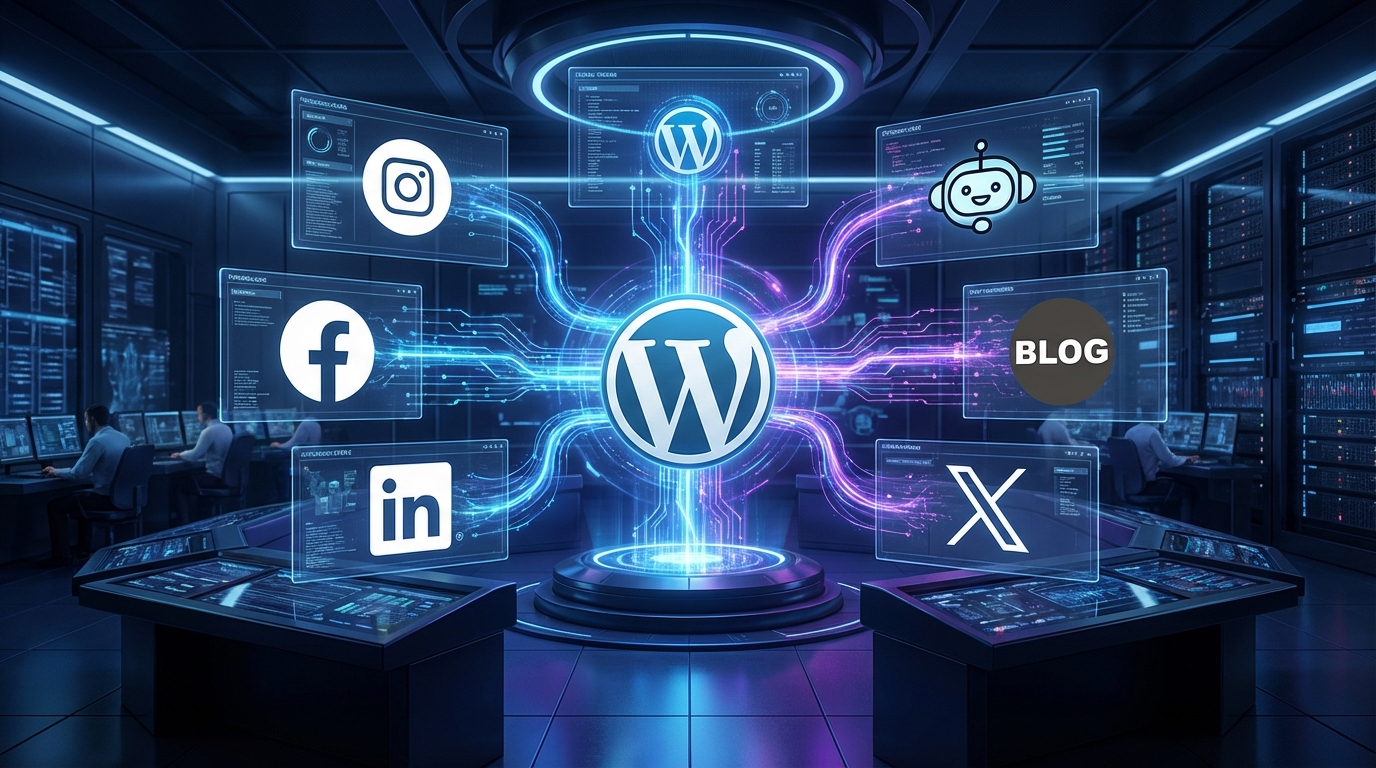
Raise your hand if you’ve ever felt personally victimized by your WordPress dashboard. I know I have. You sit down with a fresh cup of coffee, ready to tackle the big picture stuff—strategy, growth, maybe even a little creative brainstorming—and before you know it, two hours have vanished. Where did they go? Updating plugins, tweaking meta descriptions, replying to the same three questions in your chat widget, and staring blankly at Google Analytics trying to decipher if that spike in traffic was a real lead or just a bot farm in Oregon.
It’s the classic trap of the digital business owner: you build a website to give yourself freedom, but the site itself becomes a demanding boss that never sleeps. But here’s the thing—we aren’t just in the era of ‘better tools’ anymore. We’ve moved past simple automation scripts and basic plugins. We are entering the age of the AI workforce. Imagine if, instead of logging in to do the work, you logged in to check on the team doing the work for you. That is the promise of swapping your static tools for dynamic AI agents. Let’s talk about how you can fire yourself from the grunt work and turn your WordPress site into a self-driving growth engine.
The difference between a plugin and an agent
You might be thinking, "I already have plugins for everything. I have an SEO plugin, a chat plugin, and a social media auto-poster. How is this any different?" That’s a fair question. Think of a standard plugin like a power drill. It’s a fantastic tool, but it still requires you to hold it, aim it, and pull the trigger. If you walk away, the drill sits there doing absolutely nothing.
An AI agent, on the other hand, is like hiring a skilled carpenter who brings their own drill. You tell the agent, "I need a cabinet built here," and they figure out the measurements, select the materials, and get to work while you go have lunch. In the context of SynergizeFlow, this means moving from a reactive stance to a proactive one. Instead of a plugin waiting for you to write an SEO title, an agent analyzes your content and writes it for you. Instead of a chat widget waiting for you to type a reply, a lead capture agent engages the visitor, qualifies them, and books the meeting. It’s a fundamental shift from using software to collaborating with it.
Capturing leads while you sleep (for real this time)
We’ve all heard the "make money while you sleep" cliché until it’s lost all meaning. But let’s look at the reality of your website traffic. It doesn’t adhere to your 9-to-5 schedule. Potential clients are browsing your services at 2 AM, or during your kid’s soccer game. If your site relies on a static contact form, you’re essentially asking that hot lead to leave a message and wait. In the age of instant gratification, waiting is the death of conversion.
This is where a dedicated 24/7 Lead Capture Agent changes the game. Unlike a basic chatbot that regurgitates FAQ answers, an intelligent agent acts like a seasoned sales rep. It can sense intent. It asks the right qualifying questions. It guides the visitor from "just looking" to "let’s book a demo." By the time you wake up and check your dashboard, you aren’t looking at a list of generic email addresses; you’re looking at a calendar filled with qualified appointments. You didn’t have to lift a finger, and your website effectively worked a double shift without complaining.
Keeping the content machine running without burnout
Content is king, but the kingdom is exhausting to maintain. You know you need fresh blog posts to keep Google happy and your audience engaged. But finding the time to research keywords, draft outlines, write the content, and then optimize it for SEO is a massive undertaking. Usually, this falls to the bottom of the to-do list, and your blog gathers dust.
Enter the era of programmatic SEO and content agents. Imagine having an agent that doesn’t just wait for you to type, but actively looks for opportunities. It can scan your existing content, identify outdated information, and suggest—or even implement—updates. It can take a core topic and spin out high-quality, readable articles that target specific long-tail keywords. This isn’t about spamming the internet with garbage; it’s about having a tireless junior copywriter who prepares everything for your final review. Your job shifts from ‘writer’ to ‘editor-in-chief,’ giving you the creative control without the blank-page anxiety.
Social media that actually feels social
Let’s be honest: social media management is a black hole for productivity. You open LinkedIn to post a quick update, and forty minutes later you’re deep in a scroll hole, feeling bad about your productivity. Automation tools help by scheduling posts, but they often feel robotic. They blast the same message across every platform, ignoring the nuances of each audience.
A specialized Social Media Agent operates differently. It understands that a post for LinkedIn needs a different tone than a tweet or an Instagram caption. It can take one piece of core content—like that new blog post your content agent just wrote—and intelligently repurpose it into native posts for every platform. It creates the ecosystem where your content lives. More importantly, it can maintain consistency. The algorithm loves consistency, and unlike you, an agent never gets sick, never takes a holiday, and never just ‘doesn’t feel like posting today.’
Scaling your agency without the headcount headache
If you run a digital agency, you know the scaling dilemma intimately. To take on more clients, you need more staff. But hiring is expensive, training is time-consuming, and turnover is a nightmare. This bottleneck is exactly what keeps many agencies stuck in a feast-or-famine cycle. You want to offer more value to your clients, but you’re already maxed out.
White-labeling AI agents is the secret weapon for the modern agency. By deploying a suite of agents for your clients—handling their SEO, their lead gen, their social—you are effectively selling a team of experts without adding a single person to your payroll. You become the strategist who orchestrates these tools, delivering massive ROI for your clients while keeping your own margins healthy. It allows you to move from selling your time to selling outcomes, which is the only way to truly scale a service business.
Finding the right humans when you need them
Even with all this automation, there are times when you need a human touch. Maybe you need a specialized developer for a custom project, or a high-level strategist to consult on a new direction. Ironically, AI can help here too. A Recruitment Agent can scour platforms like LinkedIn, filtering through noise to find candidates that actually match your specific criteria.
It’s about having a balanced ecosystem. The goal isn’t to replace humans entirely; it’s to elevate what humans do. By letting agents handle the candidate sourcing and initial outreach, you save your energy for the actual interviews. You spend your time connecting with people, not filtering spreadsheets. It’s the final piece of the puzzle: a system that manages the work and helps you build the human team to support it.
Why this shift is inevitable for survival
We are standing at a crossroads. On one path, there are the business owners who insist on doing everything manually, wearing every hat, and drowning in the noise. On the other path, there are those who embrace the "agentic" workflow. They are building systems that run autonomously, freeing them up to focus on vision and relationships.
The WordPress ecosystem is massive, but it’s also noisy. To stand out, you can’t just work harder anymore. You have to work smarter. Integrating AI agents isn’t just a cool tech flex; it’s a survival strategy. It allows small teams to compete with giants. It allows solo founders to run empires. It levels the playing field in a way we haven’t seen since the internet first launched. So, ask yourself: do you want to be the operator of the machine, or do you want to be the architect of the system?
Final thoughts
Transforming your WordPress site into an automated engine with SynergizeFlow isn’t something that happens overnight, but it starts with a mindset shift. It starts with looking at your to-do list and realizing that 80% of it doesn’t need you specifically—it just needs to get done. By delegating these tasks to specialized AI agents, you aren’t checking out of your business; you’re checking in to the role you were actually meant to play. The CEO role. The visionary role. The role where you get to drink that coffee while it’s still hot.