You built your agency to solve problems, deliver value, and grow. But if you are like most agency owners, you have likely hit a ceiling. It is the "time for money" trap. You can only take on as many clients as your team can handle. To grow, you need to hire. To hire, you need more revenue. It is a vicious cycle that eats into your margins and keeps you awake at night worrying about quality control, deadlines, and freelancer reliability.
The traditional agency model is broken. But there is a way out. Imagine a workforce that never sleeps, never misses a deadline, and optimizes its own performance 24/7. This is not science fiction; it is the reality of modern AI automation. By integrating specialized AI agents directly into your clients’ WordPress ecosystems, you can decouple your revenue from your headcount. This article reveals how white-label AI solutions are the secret weapon you need to transform your static agency into a scalable, high-margin revenue machine.
The hidden ceiling on your agency’s growth potential
Every agency reaches a breaking point. You sign three new clients, but your content team is already at capacity. You rush to find a freelance writer, but the quality is inconsistent. You spend hours editing bad copy, fixing SEO meta tags manually, and scheduling social media posts. Suddenly, you are not a CEO; you are a project manager putting out fires.
This bottleneck is the primary reason agencies stagnate. Manual content creation and optimization are slow, expensive, and unscalable. When your service delivery relies entirely on human effort, your profit margins shrink as you scale. You are essentially building a job for yourself, not a business. To break through this ceiling, you must stop viewing content creation as a manual task and start treating it as a programmatic architecture. You need a system that executes your strategy automatically, ensuring that every client gets premium results without you lifting a finger.
Why traditional automation tools are no longer enough
You might be thinking, "I already use automation. I have Zapier, and I use a social media scheduler." While these tools are helpful, they are rudimentary. They are simple "if this, then that" scripts. They lack intelligence. They cannot analyze search intent, they cannot engage in meaningful conversations with leads, and they certainly cannot strategically optimize a blog post for better rankings over time.
True scalability requires more than just connecting apps; it requires intelligent agents. Unlike static tools, AI agents possess the cognitive ability to make decisions based on data. They don’t just post content; they create it based on real-time SEO data. They don’t just collect emails; they qualify leads through natural conversation. Relying on legacy automation tools in the age of AI is like bringing a calculator to a complex engineering problem. To dominate your niche, you need a smarter, more adaptive solution that integrates deeply with the WordPress core.
The rise of the intelligent workforce: meeting your new ai agents
The future of agency operations isn’t about better software; it’s about digital employees. Imagine deploying a specialized team for every client instantly. A Content Agent that doesn’t just write words, but crafts SEO-optimized narratives tailored to specific keywords. A Programmatic SEO Agent that constantly monitors existing posts, tweaking meta tags and readability to ensure dominance in search rankings.
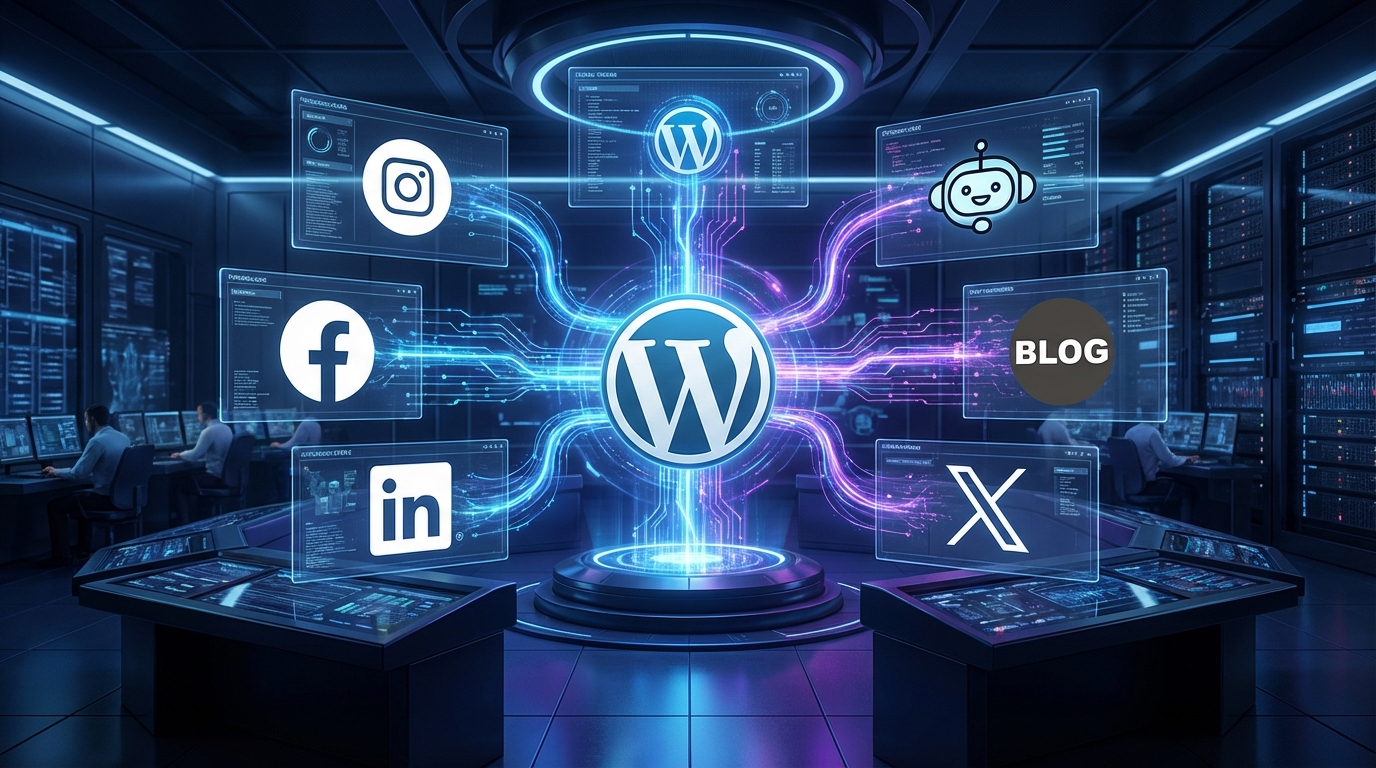
Consider the power of a Social Media Agent that doesn’t just schedule posts but repurposes your blog content into engaging snippets across all platforms, driving traffic back to the site. Add to this a 24/7 Lead Capture Agent that lives on the site, engaging visitors, answering questions, and booking appointments while your human team sleeps. SynergizeFlow enables this exact architecture. These aren’t just tools; they are a cohesive digital workforce working in harmony to drive traffic, engagement, and sales. This is the difference between a static website and an automated growth engine.
White-label ai: building your own proprietary technology stack
Here is where the true leverage lies for your agency: White-labeling. Clients don’t just buy services; they buy expertise and technology. When you can offer a "Proprietary AI Growth Engine" branded with your agency’s logo, you instantly differentiate yourself from every other generalist firm using generic tools.
By utilizing a white-label solution, you elevate your value proposition. You are no longer charging for "5 blog posts a month." You are charging for a "24/7 Automated Content & Lead Generation System." This shift allows you to increase your retainers significantly while reducing your actual labor costs. You own the technology in the eyes of your client. It builds stickiness; if they leave your agency, they lose access to the powerful engine that is driving their business. This is the ultimate retention strategy.
Automating the entire lifecycle: from keyword to conversion
The magic happens when these agents connect. In a manual agency, the SEO specialist rarely talks to the social media manager, who rarely talks to the sales team. Data gets lost in silos. AI agents, however, operate in a unified flow.
Picture this workflow: Your SEO agent identifies a high-opportunity keyword and triggers the Content Agent to generate a comprehensive, optimized article. Once published on WordPress, the Social Media Agent instantly parses the article, generates catchy hooks, and distributes them across LinkedIn, Twitter, and Facebook. When that traffic hits the site, the Lead Capture Agent is waiting to greet them, contextually aware of the content they just read. Finally, a Sales Agent identifies high-value prospects and initiates outreach. This creates a closed-loop marketing ecosystem that runs on autopilot. Your role shifts from "doer" to "architect," overseeing a system that delivers consistent, measurable ROI for your clients.
How to deploy this architecture without writing a line of code
The most common objection is complexity. "I run a marketing agency, not a software development firm." The beauty of modern AI platforms like SynergizeFlow is that they are designed for immediate deployment. You do not need to hire developers or manage complex APIs. These agents plug directly into WordPress, configured through intuitive dashboards.
You can set up a complete, white-labeled AI infrastructure for a new client in minutes, not months. This speed of implementation means you can onboard clients faster and see results sooner. It allows you to say "yes" to more business without worrying about operational drag. The barrier to entry has never been lower, but the cost of inaction is rising every day. Your competitors are already looking at these tools. The only question is whether you will lead the disruption or be disrupted by it.
Conclusion
The era of manual agency work is fading. The agencies that will thrive in the next decade are those that embrace automation not just as a tool, but as a business model. By leveraging white-label AI content automation, you are doing more than just saving time; you are unlocking infinite scale.
You have the opportunity to transform your WordPress agency into a high-margin, scalable powerhouse. Stop trading hours for dollars. Start building assets that work for you. Empower your clients with a 24/7 digital workforce and watch your retention and revenue soar. The technology is ready. The market is waiting. It is time to automate your ambition.